
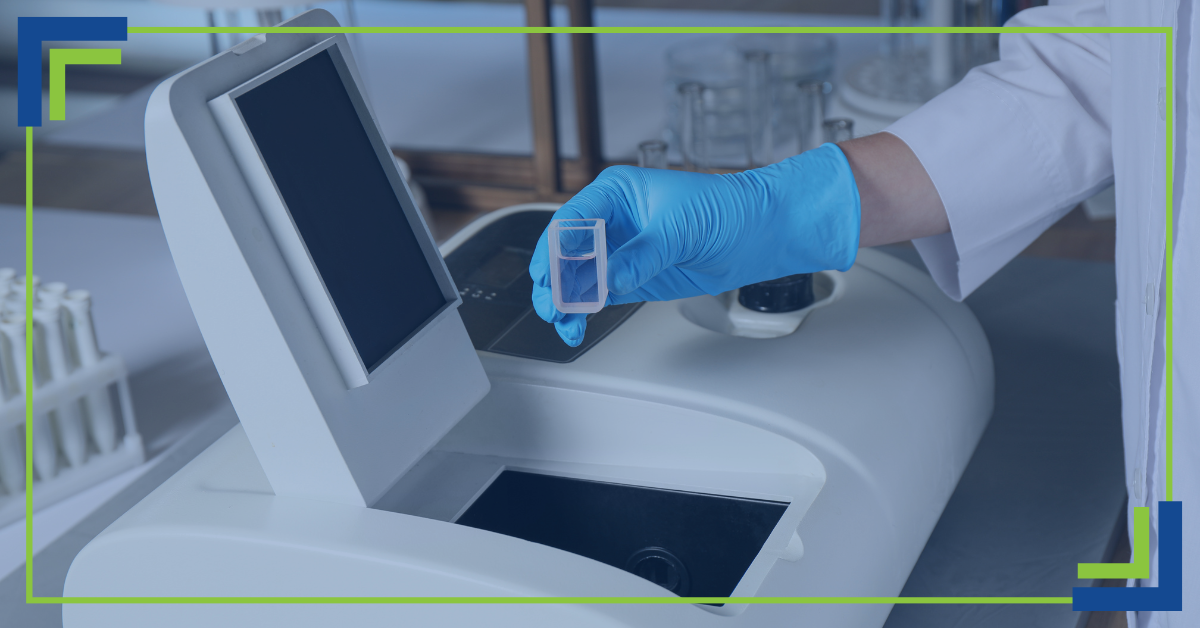
The UV-Vis spectrophotometer is one of the most widely used analytical tools in modern labs, and for good reason. It provides fast and accurate means of characterizing samples, confirming concentrations, and tracking reactions in real-time. Whether you’re working in pharmaceutical research, environmental testing, or biotech, this is an instrument your lab needs to have on hand.
This guide aims to cover everything you need to know about this versatile and essential laboratory tool.
What Is UV-Vis Spectrophotometry?
Before understanding the device itself, we need to understand the process it facilitates. UV-Vis spectrophotometry measures the amount of ultraviolet (UV) and visible light different substances absorb; different molecules absorb light at different wavelengths, and the degree of absorption at a given wavelength provides insights into the nature and quantity of a substance.
The process is governed by the Beer-Lambert Law, which states that absorbance is directly proportional to both the concentration of the absorbing material and the path-length of light through the sample. It’s expressed as:
A = εcl
Where:
- A = absorbance
- ε = molar absorptivity (a constant specific to the substance)
- c = concentration
- l = path-length
Understanding the process and the law that governs it is fundamental to interpreting the data your spectrophotometer generates.
Key Components of a UV-Vis Spectrophotometer
So how does a spectrophotometer work from a mechanical standpoint? Let’s take a look at its primary components and how they work together.
- Light Source: For UV range, instruments use a deuterium lamp. For visible range, a tungsten-halogen lamp is utilized, though certain modern models integrate both into a single source. The light source provides the broad-spectrum beam needed to make the measurement.
- Monochromator: This isolates wavelengths from the broad light source through a prism or diffraction grating. With this, only the desired wavelength (or narrow band of wavelengths) is directed toward the sample.
- Sample Holder (Cuvette): This is made from glass, disposable plastic, or quartz (for UV measurements). The cuvette is housed in a sample compartment that the selected wavelength passes through.
- Detector: After passing through the sample, it is measured by a photodetector and converted to an electrical signal.
- Data Display: The electrical signal is processed and displayed as one of three kinds of data: absorbance, transmittance, or concentration. Recent models integrate with software that allows the user to log data as well as perform spectral scanning, method storage, and report generation.
Common Laboratory Applications
What does a spectrophotometer measure in a real-world lab setting? Let’s take a look at its applications.
Measuring Sample Concentration
Technicians can determine the precise concentration of virtually any light-absorbing compound, from dyes and pigments to active pharmaceutical ingredients. This is one of the most routine uses of the instrument in quality control and R&D labs.
Monitoring Chemical Reactions
The UV-Vis spectrophotometer is an excellent tool for tracking reaction kinetics. Enzyme assays, for example, are frequently monitored this way in biochemistry labs.
Protein and DNA Quantification
Biological labs rely heavily on UV-Vis measurements for nucleic acid and protein analysis. According to a survey by the American Laboratory community, quantification of biomolecules remains one of the top five most common uses of UV-Vis spectrophotometry in life science research.
Environmental and Pharmaceutical Testing
Regulatory agencies require rigorous testing of water quality, pollutants, and pharmaceutical compounds. The UV-Vis spectrophotometer is a go-to instrument for such compliance-driven testing.
Basic Steps for Running a UV-Vis Measurement
Even if you’re an experienced laboratory technician, it’s good to revisit workflow fundamentals (especially if you don’t use this equipment on a daily basis). The standard workflow for running a UV-Vis measurement includes:
- Prepare and dilute the sample: Make sure your sample falls within the range of the Beer-Lambert Law. Dilute it with an appropriate solvent and record the dilution factor so you can use it in your calculations.
- Select the correct wavelength: Set the device to the wavelength of maximum absorbance. If you aren’t sure what that is, run a spectral scan to determine the absorbance peak.
- Calibrate with a blank sample: Fill a cuvette with your solvent or buffer and use it to zero the instrument. This process ensures that only your analyte is being measured.
- Measure absorbance or transmittance: Insert the cuvette into the device and record the absorbance or transmittance value displayed on the interface.
- Record and analyze results: Apply the Beer-Lambert equation or refer to your calibration curve to convert absorbance into concentration. Document all conditions for traceability and reproducibility.
Best Practices for Accurate Results
Even a top-of-the-line spectrophotometer will underperform if you don’t adhere to basic handling practices. The following tips will help you attain reliable data:
- Keep cuvettes clean: Fingerprints, smudges, and residue on the optical surface scatter light and introduce error. Ensure you handle cuvettes by their frosted sides and rinse thoroughly between samples.
- Avoid air bubbles: If there are bubbles in the path of the light, you may get significant absorbance artifacts. Make sure you de-gas or gently tap to remove bubbles before taking measurements.
- Warm up your instrument: 15–30 minutes of warm-up time is typically required to achieve a stable output.
- Calibrate frequently: Routinely re-zero using a fresh blank, especially when changing multiple matrices. If you’re running critical applications, run check-standards at the start and end of a session.
- Maintain consistent sample preparation: Variations in solvent, pH, temperature, or mixing can all shift absorbance values. Standardizing (and consistently following) your sample prep protocol will help you reduce run-to-run variability.
- Check your cuvettes for compatibility: If your UV measurements are below 340 nm, avoid using plastic cuvettes. Instead, use quartz to avoid artificially high absorbance readings.
Find the Right UV-Vis Spectrophotometer at BaneBio
What does a spectrophotometer measure? It ultimately comes down to one thing: light, and what happens to it when it passes through your sample. The long-term value of that measurement is what makes a UV-Vis spectrophotometer the powerhouse of lab equipment that it is. That said, only a deep understanding of the equipment and processes will allow you to unlock its full research potential.
At BaneBio, we understand that access to reliable, well-maintained analytical equipment is essential to doing good science. That’s why we offer a carefully quality-tested inventory of new and pre-owned UV-Vis spectrophotometers. Reach out to us or browse our inventory to find the right equipment for your scientific needs!